AI Chatbots in Digital Marketing: Improving Customer Experience and Lead Generation in 2026
Introduction
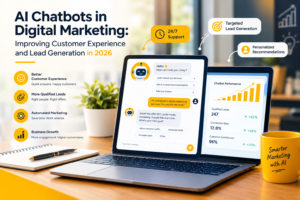
Artificial Intelligence (AI) is transforming the way businesses communicate with customers online. From answering customer questions to collecting leads and providing personalized recommendations, AI chatbots have become useful tools in modern digital marketing.
Today, customers expect quick responses, relevant information, and convenient communication. Traditional customer support methods may struggle to meet these expectations, particularly when businesses receive inquiries outside working hours. AI chatbots can help address this challenge by providing automated assistance, guiding visitors through websites, and supporting marketing campaigns.
In 2026, businesses can use AI chatbots to improve customer experience, support lead generation, and make their digital marketing activities more efficient. However, successful implementation requires accurate information, thoughtful planning, and a clear understanding of customer needs.
This blog explores what AI chatbots are, how they work in digital marketing, their benefits, practical applications, challenges, and best practices.
What Are AI Chatbots in Digital Marketing?
AI chatbots are software applications that interact with users through text or voice conversations. They can be integrated into websites, messaging platforms, and customer service systems to answer questions, provide information, and guide users toward relevant actions.
Unlike basic rule-based chatbots that follow predefined scripts, AI-powered chatbots can use natural language processing (NLP) and large language models (LLMs) to interpret user messages and generate conversational responses. Their capabilities depend on the technology, available data, and configuration used.
In digital marketing, AI chatbots can help businesses:
Answer frequently asked questions.
Recommend relevant products and services.
Collect potential customer information with appropriate consent.
Qualify leads based on their needs.
Guide users toward bookings, inquiries, or purchases.
Provide support outside normal business hours.
Assist with personalized customer communication.
For example, an online gift business can use a chatbot to ask customers about their budget, occasion, preferred products, and delivery requirements before suggesting suitable gift hampers.
How Do AI Chatbots Work?
AI chatbots generally follow a conversational process to understand a user’s request and provide an appropriate response.
1. Understanding Customer Questions
The chatbot processes a customer’s message to identify the intent behind the question. For example, it may recognize whether someone wants product information, pricing, delivery details, or assistance with an order.
2. Finding Relevant Information
Depending on its setup, the chatbot may use predefined answers, a connected knowledge base, product information, or approved business data to find a relevant response.
3. Generating a Response
The chatbot provides an answer or recommends the next step. Advanced AI systems can generate more natural responses, but they may still produce inaccurate information if not properly configured.
4. Guiding the Customer
The chatbot can direct the user to a product page, booking form, contact page, or human support representative.
5. Supporting Marketing Analysis
When configured appropriately and with suitable privacy safeguards, chatbot interactions can help businesses understand common customer questions, identify areas of interest, and improve their marketing strategies.
Benefits of AI Chatbots in Digital Marketing
1. Improved Customer Experience
Customers often want quick answers before deciding whether to purchase a product or service. AI chatbots can provide immediate assistance with common questions about pricing, product availability, services, and delivery.
This reduces unnecessary waiting and helps visitors find information more conveniently. Businesses should ensure that customers can reach a human representative when a chatbot cannot resolve their concerns.
2. Better Lead Generation
Lead generation involves attracting potential customers and collecting relevant information to support future communication.
AI chatbots can ask visitors about their requirements, budget, business type, or preferred service. Based on the answers, they can direct suitable prospects toward an inquiry form, consultation booking, or sales representative.
For example, a digital marketing agency could ask a visitor whether they need SEO, social media marketing, Google Ads, or website development. This helps the business understand the visitor’s interests before following up.
3. Personalized Product Recommendations
AI chatbots can use information provided during a conversation to recommend relevant products or services.
An online clothing store might ask about preferred styles, sizes, occasions, and budgets. It can then direct customers toward suitable collections, provided the product information is accurate and up to date.
Personalization should be transparent and respectful of customer privacy.
4. Support Beyond Business Hours
A chatbot can answer common questions even when a business’s employees are unavailable. This is particularly useful for online stores, service providers, and businesses that receive inquiries at different times.
However, automated availability does not mean every issue can be resolved immediately. Complex complaints, payment disputes, and sensitive requests may require human support.
5. More Efficient Marketing Operations
Chatbots can automate repetitive tasks, including answering FAQs, collecting inquiry details, and directing users to relevant resources.
This allows marketing and sales teams to spend more time on complex customer needs, campaign planning, and relationship building.
The actual time and cost savings depend on the quality of implementation and the volume of inquiries handled.
6. Better Customer Engagement
Interactive conversations can encourage visitors to explore products, learn about services, and take the next step.
For instance, a website chatbot might offer a product guide, explain a service package, or help a visitor book a consultation. These interactions can make the customer journey more convenient when they are relevant rather than intrusive.
How AI Chatbots Improve Lead Generation
AI chatbots can support multiple stages of the lead generation process.
Step 1: Attract Website Visitors
Businesses can introduce a helpful chatbot on important website pages, such as service pages, product pages, and pricing pages.
The chatbot should offer assistance related to the page rather than interrupting visitors with irrelevant messages.
Step 2: Understand Customer Intent
The chatbot can ask simple questions to understand what the visitor is looking for.
For example:
What service are you interested in?
What is your approximate budget?
When do you need the service?
Would you like to schedule a consultation?
Only collect information that is necessary for the stated purpose.
Step 3: Qualify Potential Leads
Based on the answers, the chatbot can categorize inquiries according to service requirements, budget, urgency, or other relevant criteria.
This helps sales teams prioritize follow-ups. Qualification rules should be clear, relevant, and regularly reviewed.
Step 4: Collect Contact Information
When appropriate, the chatbot can invite the visitor to provide an email address or phone number for a requested follow-up. Businesses should explain how the information will be used and obtain any consent required for marketing communications.
Step 5: Guide the Lead to the Next Action
The chatbot can help the visitor book a meeting, submit a project brief, request a quotation, or explore relevant service pages.
Step 6: Measure the Results
Businesses should evaluate chatbot performance using metrics such as qualified leads generated, lead-to-customer conversion rate, completed bookings, customer satisfaction, and the number of conversations transferred to human agents.
The number of conversations alone does not indicate marketing success. The quality and outcomes of those conversations matter more.
Practical Examples of AI Chatbots in Digital Marketing
E-commerce Businesses
Online stores can use chatbots to answer questions about products, sizes, stock, shipping, and return policies. They can also guide customers toward suitable products.
Digital Marketing Agencies
Agencies can use website chatbots to identify potential clients, explain available services, collect project requirements, and schedule consultations.
Educational Institutions
Training institutes can use chatbots to answer questions about courses, eligibility, fees, schedules, and enrollment procedures. Information about admissions and fees should be kept accurate and current.
Healthcare Providers
Healthcare websites may use carefully designed chatbots to provide general administrative information, explain appointment procedures, and help visitors find appropriate contact details. They should not replace qualified medical professionals or provide unsupported diagnoses.
Local Businesses
Small businesses can use chatbots to respond to questions about opening hours, product availability, service areas, appointments, and location.
For example, a gift business can help visitors discover birthday hampers, anniversary gifts, and customized bouquets based on their budget and occasion.
Popular AI Chatbot Tools for Businesses
The right tool depends on a business’s budget, existing platforms, technical requirements, and customer communication needs.
1. Tidio
Tidio offers customer communication tools, including live chat and chatbot automation. It can be useful for businesses looking to manage website inquiries and support e-commerce interactions.
2. Intercom
Intercom provides customer service and conversational support capabilities, including AI-assisted workflows. It may suit businesses that need more structured customer support operations.
3. Manychat
Manychat supports automated conversations on supported messaging and social platforms. It can be useful for businesses that want to automate selected interactions and marketing workflows.
4. HubSpot
HubSpot offers CRM and marketing tools, including conversational features that can help businesses manage leads and customer interactions within a broader marketing workflow.
5. Chatbase
Chatbase provides tools for creating AI chatbots that can respond using supplied business information. It may be useful for businesses that want a chatbot to answer questions about their content or services.
Features, integrations, pricing, and platform availability can change. Businesses should check each provider’s current documentation before choosing a tool.
Best Practices for Using AI Chatbots in Digital Marketing
To achieve better results, businesses should follow these practical recommendations.
1. Define a clear objective: Decide whether the chatbot is intended to answer FAQs, generate qualified leads, support sales, or improve customer service.
2. Use accurate information: Build the chatbot around reliable, updated product details, service descriptions, policies, and frequently asked questions.
3. Keep conversations simple: Ask only necessary questions and avoid making users navigate lengthy or confusing conversation flows.
4. Provide human support: Make it easy for users to contact a person when the chatbot cannot answer confidently or the issue requires human judgment.
5. Respect privacy: Explain data collection practices, protect personal information, and comply with applicable privacy and marketing communication requirements.
6. Measure meaningful outcomes: Track lead quality, completed actions, customer satisfaction, and conversion rates instead of focusing only on conversation volume.
7. Test and improve regularly: Review unanswered questions, incorrect responses, drop-off points, and customer feedback. Update the chatbot when business information or customer needs change.
Challenges and Limitations of AI Chatbots
Although AI chatbots offer many benefits, businesses should understand their limitations.
Inaccurate Responses
Generative AI systems may provide incorrect or misleading information. Businesses should use reliable knowledge sources, define clear limitations, and test responses regularly.
Lack of Human Understanding
Chatbots may struggle with emotional situations, complicated complaints, sarcasm, or unusual requests. Human assistance remains important for sensitive and complex interactions.
Privacy and Security Risks
Chatbots may process personal information, so businesses need suitable security controls, transparent privacy practices, and appropriate data retention policies.
Implementation Costs
Some chatbot platforms require paid subscriptions, integration work, maintenance, or technical support. Businesses should compare these costs with measurable operational and marketing benefits.
Over-Automation
Excessive automation can frustrate customers who prefer human communication. Chatbots should support customer service rather than create barriers to it.
The Future of AI Chatbots in Digital Marketing
AI chatbots are becoming more capable of understanding conversational requests, connecting with business systems, and supporting customer journeys across digital channels.
Future applications may include more contextual product recommendations, improved lead qualification, multilingual assistance, and closer integration with CRM and marketing automation platforms.
However, the most effective approach is not simply to automate every interaction. Businesses need to combine useful automation with accurate information, responsible data practices, human oversight, and a customer-focused strategy.
As AI technology develops, companies that evaluate chatbot performance carefully and adapt to customer feedback will be better positioned to use these tools effectively.
Conclusion
AI chatbots are valuable tools for businesses that want to improve customer experience and strengthen lead generation. They can answer common questions, provide relevant recommendations, qualify potential customers, and guide website visitors toward meaningful actions.
Their success depends on more than the technology itself. Accurate information, thoughtful conversation design, privacy protection, human support, and ongoing performance measurement are essential for building trust.
For businesses adopting digital marketing strategies in 2026, AI chatbots can be a useful addition to a broader approach that combines SEO, content marketing, social media, paid advertising, and customer relationship management.
The goal should be to use AI to make customer interactions more helpful, efficient, and relevant—not to remove the human element from marketing.