
Search Engine Marketing(SEM)
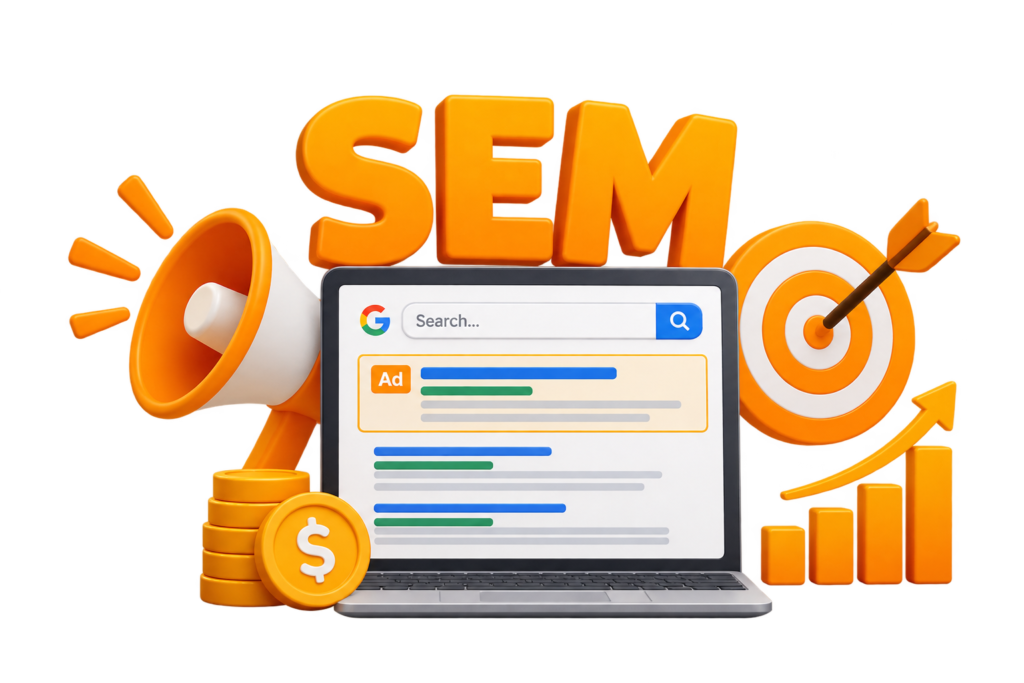
Search Engine Marketing (SEM) is paid advertising that boosts website visibility on search engine results pages, with advertisers bidding on keywords and paying per click to drive targeted traffic and conversions
Search Engine Marketing(SEM)
Digital marketing strategy used to promote businesses, products, and services through search engines such as Google and Bing. It mainly focuses on paid search advertising, where businesses pay to display their advertisements to users who are actively searching for relevant keywords. SEM helps websites appear at the top of search results and increases their visibility among potential customers.
SEM includes several important activities such as keyword research, campaign planning, ad creation, audience targeting, bidding, budget management, and performance tracking. Marketers identify high-value keywords that potential customers are searching for and create relevant advertisements around those keywords. They can also target users based on factors such as location, interests, devices, demographics, and search behavior.
One of the major advantages of SEM is that it can deliver quick and measurable results. Businesses can attract targeted traffic, generate leads, increase online sales, and improve brand awareness. SEM also provides detailed performance data, including clicks, impressions, conversion rates, and advertising costs, allowing marketers to continuously optimize campaigns and achieve better returns on investment.
What is Included in sem
Search Intent Analysis
Search Intent Analysis is the process of understanding what users want when they enter a search query. It helps marketers identify whether users are seeking information, comparing products, finding a specific website, or ready to purchase. Understanding search intent allows businesses to select relevant keywords, create targeted ads, and provide suitable landing pages. This improves ad relevance, attracts qualified visitors, increases engagement, and supports better lead generation and conversions.
Audience Targeting
Audience Targeting is the process of showing SEM advertisements to specific groups of potential customers who are most likely to be interested in a product or service. Marketers can target audiences based on factors such as location, age, interests, device, language, search behavior, and previous website interactions. Effective audience targeting helps businesses reach the right people, reduce unnecessary ad spending, improve engagement, increase qualified traffic, and generate better leads and conversions.
Competitor Analysis
Competitor Analysis in SEM involves studying competitors’ keywords, advertisements, offers, landing pages, and search strategies. It helps businesses understand what works in their industry and identify opportunities to improve their campaigns. By analyzing competitors, marketers can discover new keywords, create better ad copies, develop attractive offers, and improve targeting. This helps businesses attract qualified traffic, increase ad performance, and gain a stronger position in search engine results.
Quality & Relevance Optimization
Quality & Relevance Optimization focuses on improving the connection between targeted keywords, ad copy, and landing pages in SEM campaigns. Marketers ensure that advertisements closely match users’ search queries and provide clear, useful information. Relevant landing pages improve user experience and encourage visitors to take action. This optimization can improve ad quality, increase click-through rates, reduce unnecessary costs, attract qualified traffic, and support better conversions and overall campaign performance.
Landing Page Optimization
Landing Page Optimization is the process of improving a webpage that users visit after clicking an SEM advertisement. It ensures that the landing page is relevant to the search query and matches the message of the advertisement. Marketers optimize headlines, content, images, forms, navigation, loading speed, mobile responsiveness, and calls-to-action. A well-optimized landing page provides a better user experience, builds trust, increases engagement, improves conversion rates, reduces wasted ad spending, and supports better overall SEM campaign performance.
Campaign Setup & Management
Campaign Setup & Management involves planning, creating, launching, and monitoring SEM advertising campaigns. It includes selecting campaign goals, researching relevant keywords, organizing ad groups, creating engaging advertisements, setting budgets, choosing bidding strategies, and targeting the right audience. Marketers regularly monitor campaign performance and optimize keywords, ads, bids, budgets, and targeting. Effective campaign management helps improve ad visibility, control costs, attract qualified traffic, generate leads, and achieve better conversions.
Why Has SEM Become Important?
Search Engine Marketing (SEM) has become an important part of digital marketing because it helps businesses reach potential customers when they are actively searching for products, services, or solutions online. Search engines such as Google have become a major source of information for consumers, making search visibility essential for businesses of all sizes. SEM allows businesses to place paid advertisements prominently on search engine results pages and gain visibility even when their website has not yet achieved strong organic rankings. This can help businesses attract relevant website visitors, increase brand awareness, generate enquiries, and drive sales more quickly.
One of the biggest advantages of SEM is its ability to provide targeted and controlled advertising. Businesses can select relevant keywords based on what their potential customers are searching for and create advertisements that match their needs. SEM campaigns can also be targeted according to location, language, device, audience characteristics, and search behavior. This allows businesses to focus their advertising budget on users who are more likely to become customers. Marketers can control daily budgets, adjust bids, pause underperforming campaigns, and allocate more resources to advertisements that generate better results. This level of control makes SEM suitable for both small businesses with limited budgets and larger organizations running extensive advertising campaigns.
SEM is also important because it can provide quick and measurable results. Unlike many organic marketing activities that may require considerable time to produce results, paid search campaigns can begin generating impressions and clicks soon after they are launched. Businesses can monitor important performance metrics such as impressions, clicks, click-through rate, cost per click, conversions, conversion rate, cost per conversion, and return on advertising spend. These insights allow marketers to understand customer behavior and identify which keywords, advertisements, audiences, and landing pages are performing well. Based on this data, campaigns can be continuously optimized to improve performance and reduce unnecessary advertising costs.
Another important benefit of SEM is its ability to support lead generation and sales. When users search for products or services with strong purchase intent, relevant search advertisements can connect them directly with businesses that can meet their needs. For example, a person searching for “digital marketing agency near me” may already be interested in hiring a service provider. A well-designed SEM campaign can display a relevant advertisement and direct the user to an optimized landing page where they can make an enquiry, book a service, or complete a purchase. This makes SEM particularly valuable for businesses that want to turn search traffic into measurable business outcomes.
Frequently Asked Questions
What is SEM?
SEM stands for Search Engine Marketing. It is a digital marketing strategy that uses paid advertisements on search engines to increase website visibility and attract potential customers.
How does SEM work?
SEM works by targeting relevant keywords that users search for. Businesses create paid advertisements that appear on search engine results pages and pay based on the selected advertising model.
What is the difference between SEM and SEO?
SEO focuses on improving organic search rankings, while SEM primarily uses paid search advertising to gain visibility and attract targeted traffic.
How long does it take to see SEM results?
SEM can start generating visibility and traffic shortly after a campaign is launched. However, achieving strong and consistent results usually requires continuous monitoring and optimization.
Can SEM generate leads and sales?
Yes. A well-planned SEM campaign can attract high-intent users and direct them to optimized landing pages, helping generate leads, enquiries, purchases, and other conversions.
Why is SEM important for businesses?
SEM helps businesses gain quick visibility, reach targeted customers, generate leads, increase website traffic, and improve sales through measurable advertising campaigns.
How much does SEM cost?
The cost depends on factors such as keywords, competition, target location, audience, campaign objectives, and budget. Businesses can set and control their advertising budget.
What is Google Ads in SEM?
Google Ads is a popular advertising platform used to create and manage paid search campaigns. Businesses can use it to display advertisements when users search for relevant keywords.
Let's Connect
My focus is on building trust, maintaining transparency, and delivering quality that reflects your brand’s true identity. Let’s build your digital presence with the best digital marketing consultant in Calicut, Kerala